
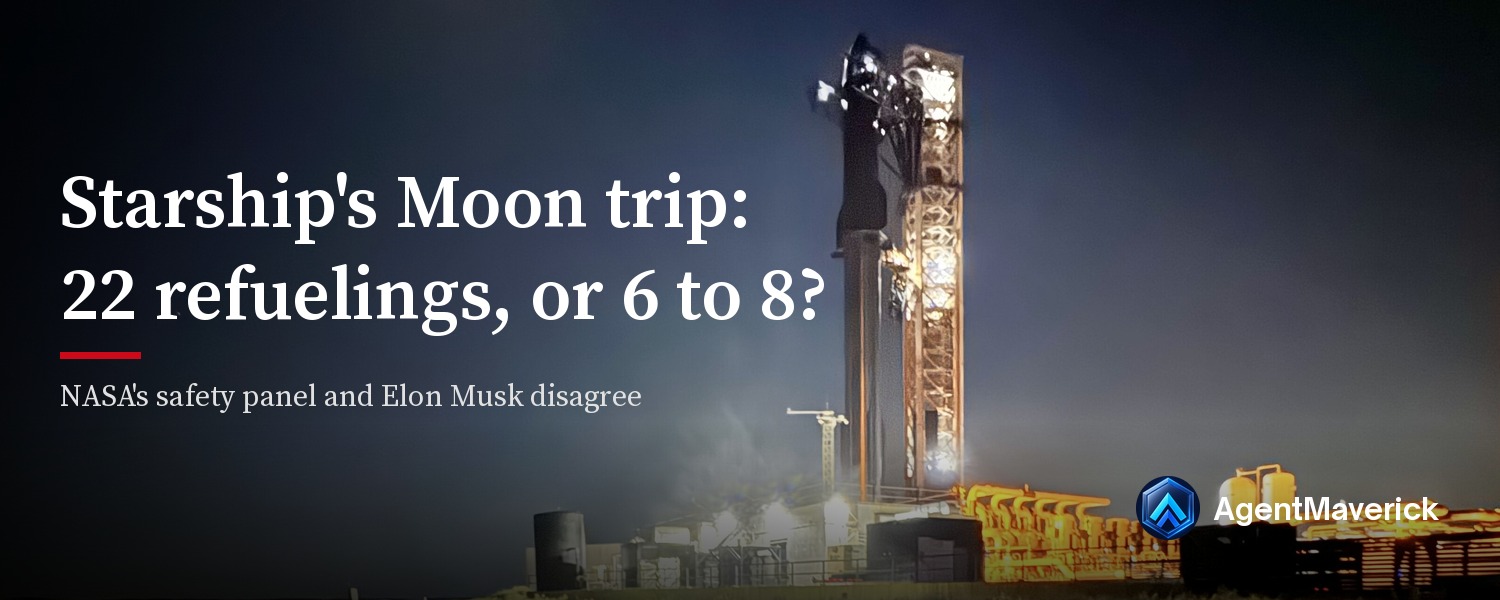
NASA's safety advisers think a Starship Moon landing needs around 22 launches to fill its tanks in orbit. Elon Musk says the real number will be more like 6 to 8. The gap between those figures is the gap between a lander that arrives on time and one that does not, and it decides how much the United States' return to the Moon costs.
What the panel said
At the quarterly meeting of NASA's Aerospace Safety Advisory Panel on Oct. 22, member Charlie Precourt, a former NASA astronaut, flagged the lander's fueling as a risk to the first crewed landing. "We need to keep our eyes on numerous required fuelings for the lander," he said. "I think the last estimate is around 22 flights." Eric Berger of Ars Technica reported the remark from the call.
Precourt did not name Starship, but it is the only NASA lander that depends on refueling in orbit. Blue Origin's Blue Moon is not designed to use it on its first mission.
Musk replied within hours on X. "That's way too high," he wrote. "Actual number will be more like 6 to 8." NASA Administrator Jared Isaacman did not pick a side. According to Ars Technica, he said Musk's range was possible but represented the "ultimate potential end state" of Starship, not where it stands today. NASA officials declined to give their own number. Bloomberg's Loren Grush summed up the situation on Oct. 28: no one yet knows how many refills the rocket will need.
How orbital refueling works
Starship cannot launch with enough propellant to reach the Moon, land and climb back to orbit. A rocket that leaves the ground with full tanks burns most of them getting to orbit. SpaceX's answer is to refill the ship once it is up there.
The plan has four parts. First, SpaceX launches a depot, a Starship that stays in low Earth orbit and stores liquid methane and liquid oxygen. Second, a series of tankers, which SpaceX describes as Starships "minus the windows," launch one after another, dock with the depot and pump their leftover propellant across. Third, the lander, a Starship variant built for the Moon, docks with the depot and takes on a full load. Fourth, under NASA's revised plan, Orion and its crew dock with the lander in Earth orbit, and the lander carries both to low lunar orbit.
Two physical problems sit inside that plan. The first is boil-off. Methane and oxygen are stored as very cold liquids, and sunlight and warm hardware slowly turn some of them into gas that has to be vented. The longer the depot waits for the next tanker, the more it loses. The second is transfer. In weightlessness, liquids do not settle at the bottom of a tank, so pumping them from one ship to another without gulping gas is hard. Starship has only moved liquid oxygen between tanks inside one vehicle, on Flight 3 in March 2024. It has never moved propellant between two ships.
How the estimate has moved
The number has never been fixed. In 2023, Lisa Watson-Morgan, then head of NASA's Human Landing System program, put it in the "high single digits to the low double digits." Later that year, SpaceNews reported, NASA officials said "high teens." NASA had also said at least 15 Starship launches would be needed in total. Grokipedia's Starship HLS entry cites planning figures of 10 to 16 tanker flights.
This month the panel's figure rose to about 22. Musk's answer went the other way, to 6 to 8. Isaacman's framing explains the split: the panel is pricing in today's Starship, and Musk is describing a mature one.
The Version 3 math
The simplest way to see the gap is to divide the propellant the lander needs by the propellant each tanker can bring. The worked figures below use only SpaceX's published numbers and make deliberately simple assumptions.
Worked calculation (illustrative, not a mission plan)
Ship propellant capacity, Version 3: 1,600 tonnes (SpaceX specification page).
Payload to orbit, Version 3, fully reusable: "100+" tonnes (SpaceX). We treat a tanker's delivered propellant as roughly equal to that payload, 100 tonnes.
Assumption 1: the lander must be filled from empty to its full 1,600 tonnes.
Assumption 2: no boil-off and no transfer losses.
Result: 1,600 ÷ 100 = 16 tanker flights.
To reach Musk's 6 to 8, each tanker would need to deliver about 1,600 ÷ 8 = 200 tonnes to 1,600 ÷ 6 ≈ 267 tonnes, or the lander would need far less than a full load. A planned Version 4 Starship is listed on reference sites with an estimated 200 tonnes to orbit, which is the scale Musk's range implies.
The real answer can move either way. Boil-off and transfer losses push the count up, which is how a figure near 22 becomes plausible. NASA's revised plan pushes it down: because the lander now meets Orion in Earth orbit rather than near the Moon, NASA says Starship will need "significantly" less propellant in orbit. A larger tanker would cut it further. That is why the estimates spread so widely.
Why the count matters: the cadence
Every tanker is a full Starship launch. Ars Technica estimates that even at the twice-weekly cadence Musk is targeting for late 2027, 22 launches would take about three months. The chart shows the simple arithmetic. At one launch a week, 22 flights take 154 days. At two, 77 days. At seven a week, one a day, 22 days. Six flights at two a week take three weeks.
Time is not neutral here. Each extra week in orbit means more boil-off, and more boil-off means more tankers. Cadence and count feed each other.
Starship has flown 14 test flights in total, and only Flight 14 on Sept. 28 reached orbit.
The business case
NASA picked SpaceX in April 2021 with a $2.89 billion fixed-price contract to develop Starship HLS. In November 2022 it added Option B, worth about $1.15 billion, for an upgraded lander and a second crewed landing, taking the total to about $4.05 billion. NASA's Inspector General put the contract's total potential value at about $4.3 billion in a March 2026 report. Because the contract is fixed-price, SpaceX, not NASA, pays if more tankers are needed.
That is why reuse is the whole business case. SpaceX says that if tankers are highly reusable, "the primary cost is just that of the oxygen and methane, which is extremely low." SpaceX has not published a price for a Starship launch. Catching and quickly reflying boosters and ships is what would turn 22 launches from a budget problem into a scheduling one.
The money comes largely from SpaceX itself. President Gwynne Shotwell said in 2023 that cash flow from operations pays for development, with outside investment as needed. In August 2025, Musk agreed with a post saying Starship development is funded through Starlink subscription revenue, and said NASA accounted for about $1 billion of SpaceX's roughly $15 billion revenue that year.
The competition is real. Blue Origin holds a separate $3.4 billion NASA contract for its Blue Moon lander, and NASA has not yet chosen which lander will carry the first crew. China is aiming to land astronauts by 2030.
The timeline
The next step is Flight 15. FAA air-traffic planning slides now list it no earlier than Nov. 12, up from Nov. 8, and SpaceX plans to try to catch both the Super Heavy booster and the ship with the launch tower. That would be the first full recovery of an orbital rocket.
The test that matters most comes after. Shotwell is targeting the first ship-to-ship propellant transfer for early 2027. That test was once planned for March 2025.
Under NASA's revised plan, Artemis III, targeted for the third quarter of 2027, is now a crewed test in Earth orbit, with Orion docking with test versions of both companies' landers. The first landing has moved to Artemis IV, targeted for early 2028.
What the doubters get right, and wrong
The doubters are right on the record. Ship-to-ship transfer has never been done. The transfer test is about two years behind its first target. Starship reached orbit for the first time a month ago. The safety panel's job is to price in that history, and 22 is a defensible number for today's vehicle.
They are wrong to treat 22 as fixed. The count depends on tanker size, boil-off and the mission profile, and two of those just changed in SpaceX's favor: Version 3 carries more, and NASA's new plan asks the lander to collect less. The contract is fixed-price, so the extra launches are SpaceX's cost, not taxpayers'. And the estimate has already moved by a factor of two in three years.
Musk's 6 to 8 is a goal for a mature system, as NASA's own administrator said. The panel's 22 is a measure of where things stand. The ship-to-ship test in 2027 will be the first hard data either side has had.
The number that decides America's Moon landing has never been measured.
Sources: NASA Aerospace Safety Advisory Panel meeting (Oct. 22, 2026), as reported by Ars Technica; Musk post on X (Oct. 22, 2026); Bloomberg (Oct. 28, 2026); Grokipedia, "Starship HLS"; SpaceX Starship specifications (spacex.com/vehicles/starship); NASA, "NASA Awards SpaceX Second Contract Option for Artemis Moon Landing" (Nov. 15, 2022); SpaceNews (2023; Nov. 2022); NASA Office of Inspector General report IG-26-004 (March 2026); FAA air-traffic planning slides; NASA revised Artemis plan (Oct. 2026); Advanced Television, Shotwell remarks (Feb. 2023).